

Aquarium Foundations
The nitrogen cycle, beneath the surface
Why biological filtration matters, and why clear water is not proof that an aquarium is ready for fish.
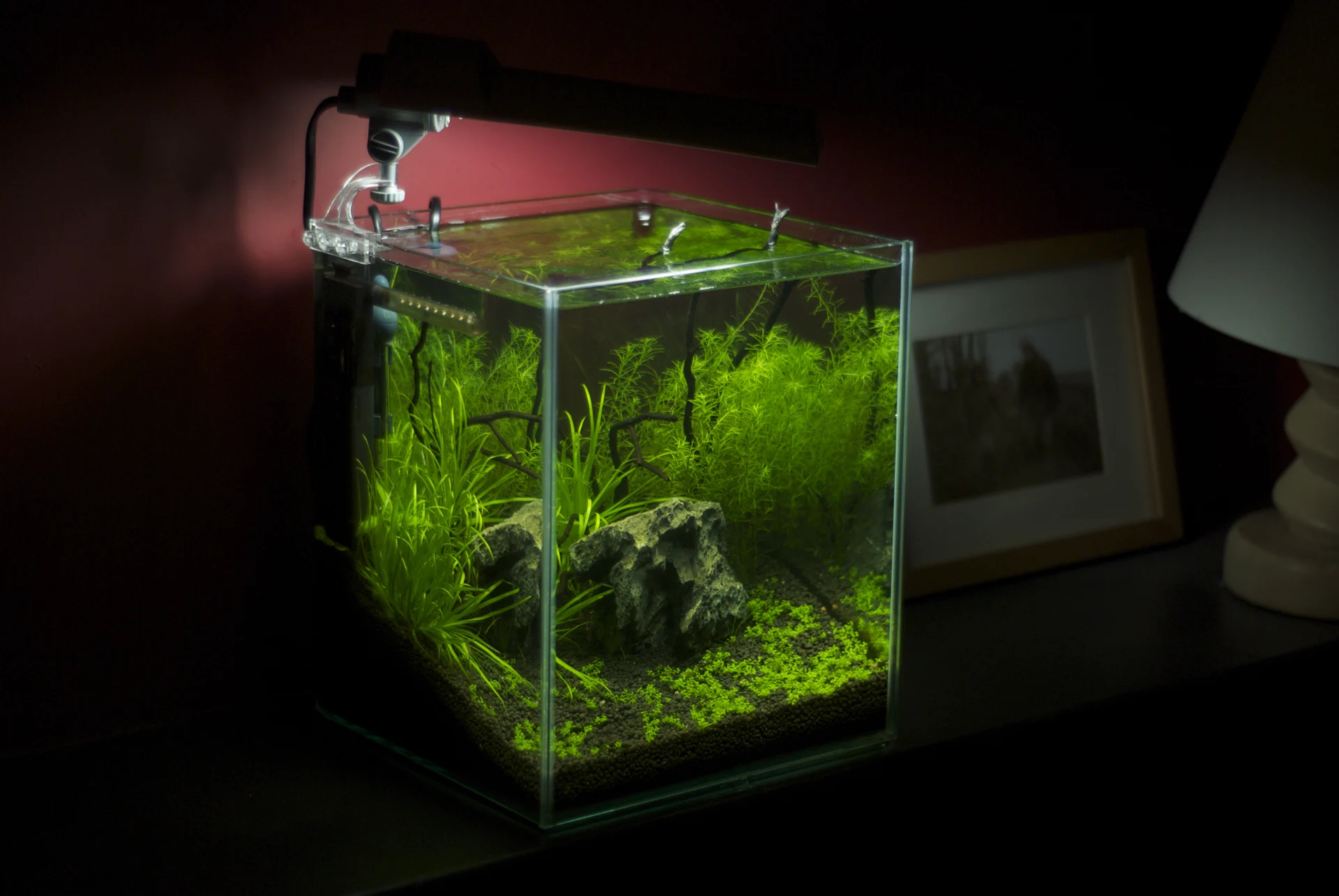
Where fish waste goes
Fish release ammonia, and decomposing feed and other organic material can add more. In an aquarium, this waste can accumulate. Water may look clear while containing harmful levels of ammonia; testing provides information that appearance cannot.[1]
Ammonia risk is also affected by pH and temperature. A test result needs context, rather than a judgement based only on whether the water looks clean.[2]
A living filter
In biological filtration, microorganisms convert ammonia to nitrite and then nitrate. Both ammonia and nitrite can harm fish. The organisms responsible need suitable conditions, including oxygen, and surfaces on which to establish.[1,4]
This is why installing a new filter is not the same as establishing biological filtration. The equipment provides habitat for a process; it does not make that process mature immediately.[4]
Measure readiness, not just time
Biofilter establishment can take weeks or longer. Temperature, pH, oxygen, feeding, and system design affect the process, so a fixed calendar date cannot guarantee readiness.[3,4]
Keep water-quality records and seek an appropriate fishless-cycling plan before stocking. Continue monitoring after changes in stocking or feeding. If fish appear unwell, check water quality and seek qualified fish-health advice rather than assuming an infection or adding medication without a diagnosis.[3]
Understand the records behind the water.
Take these questions into your further reading.
- What do your test instructions actually measure, and in which units?
- Which feeding, maintenance, or stocking changes are recorded alongside your water-test results?
- What species-specific guidance do you still need before interpreting those results or making a change?
This is a learning checklist, not a treatment or husbandry protocol.
Sources & further reading
- Nitrogen biogeochemistry of aquaculture ponds. Aquaculture. 1998;166(3–4):181–212. doi:10.1016/S0044-8486(98)00298-1
- Aqueous ammonia equilibrium calculations: effect of pH and temperature. Journal of the Fisheries Research Board of Canada. 1975;32(12):2379–2383. doi:10.1139/f75-274
- Water quality requirements for reuse systems. Aquacultural Engineering. 2006;34(3):143–156. doi:10.1016/j.aquaeng.2005.08.011
- Nitrification filter principles. In: Timmons MB, Losordo TM, editors. Aquaculture Water Reuse Systems: Engineering Design and Management. 1994;Developments in Aquaculture and Fisheries Science 27:101–126. Elsevier. Available from: https://www.sciencedirect.com/bookseries/developments-in-aquaculture-and-fisheries-science/vol/27/suppl/C
Sources reviewed on 1 September 2026. References support this introduction; they do not imply endorsement of LIMNIC. For species-specific care or health concerns, consult an appropriate specialist.