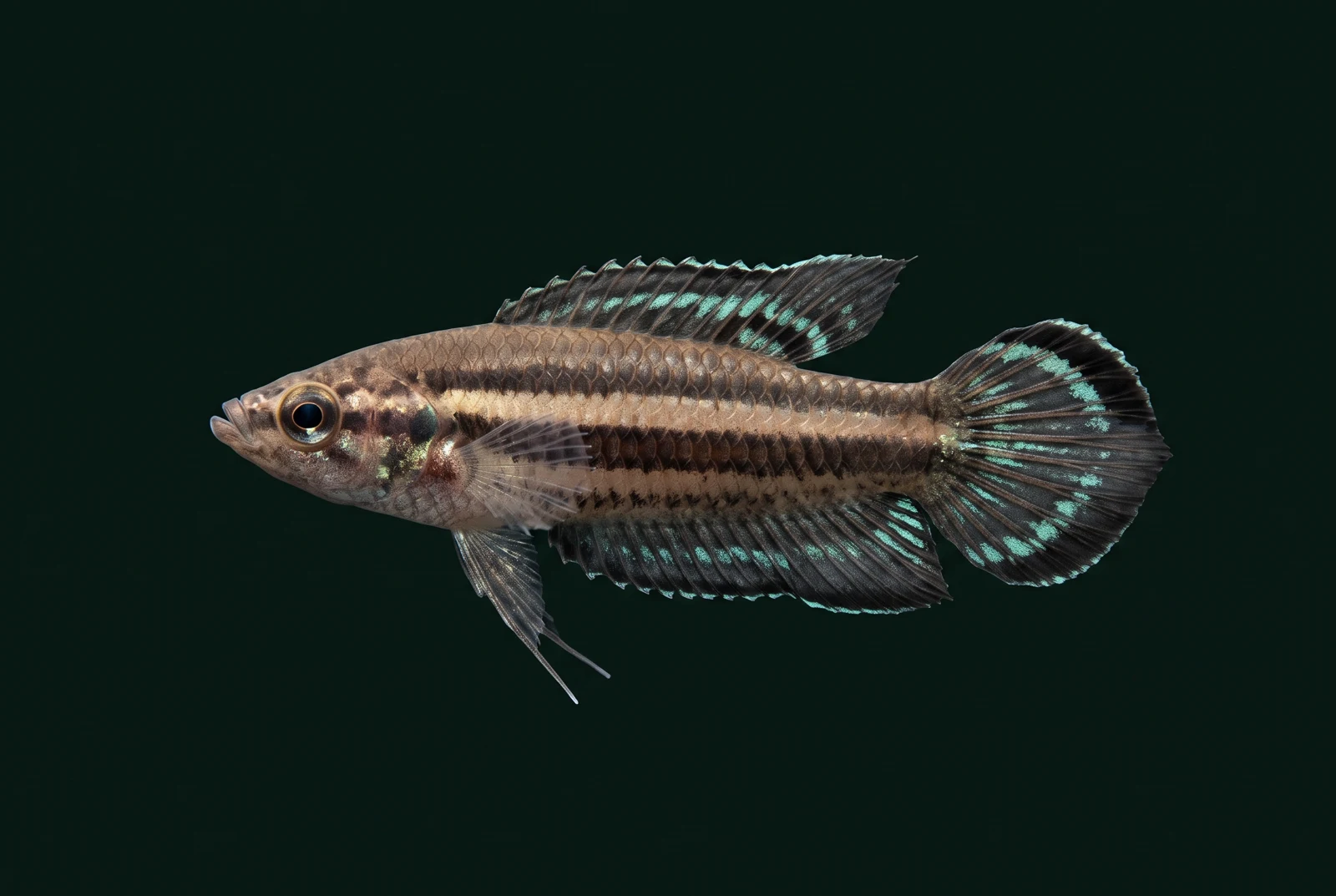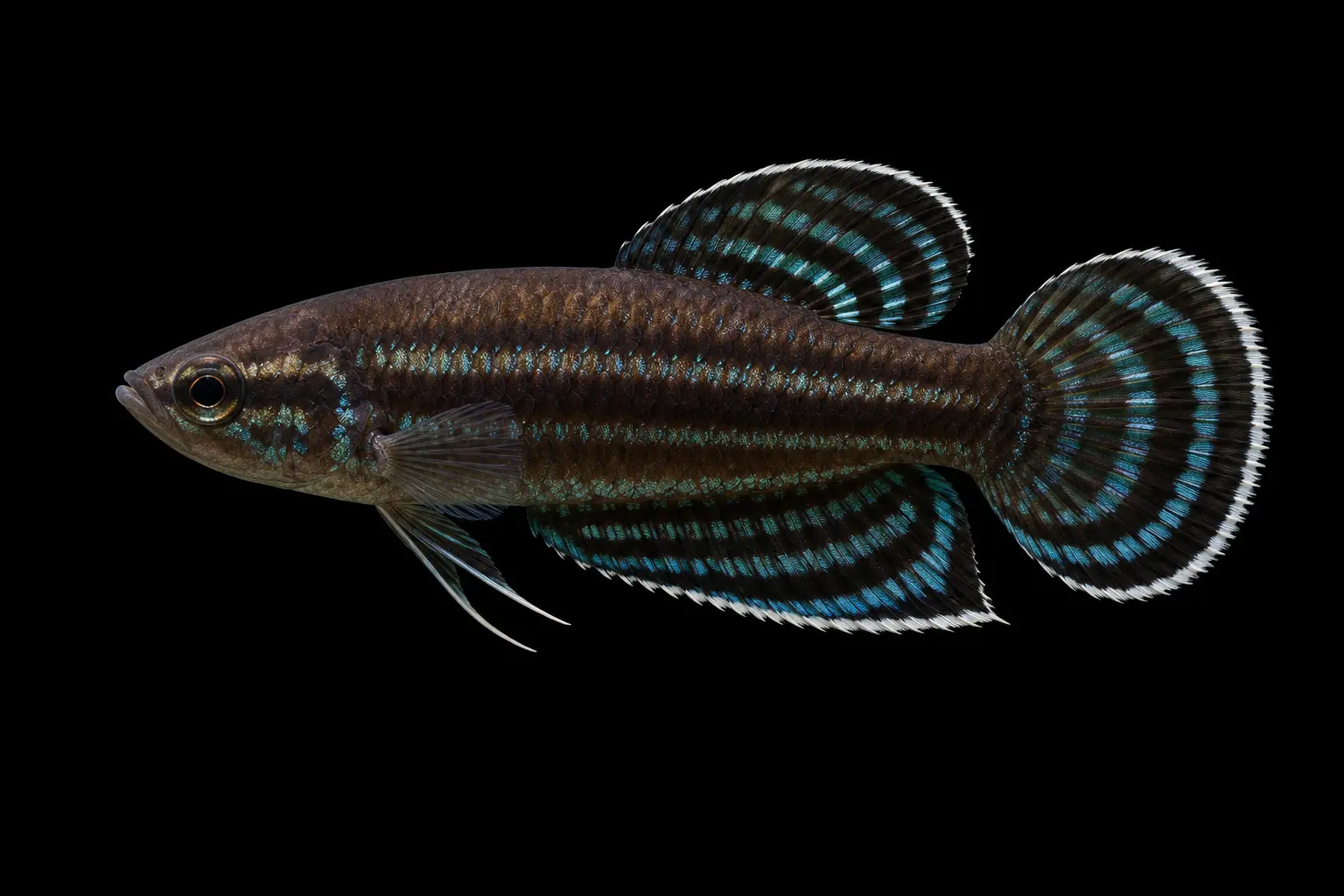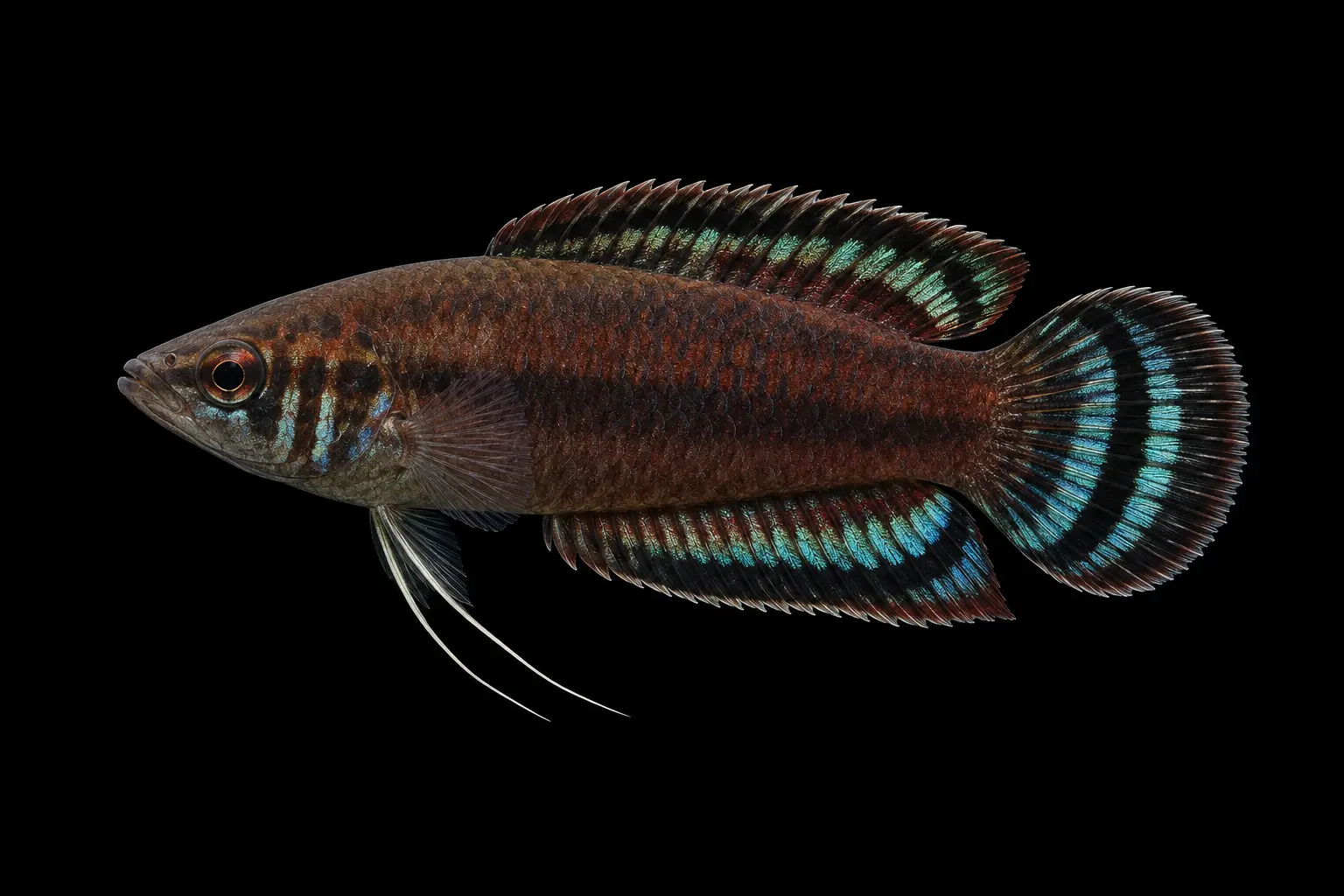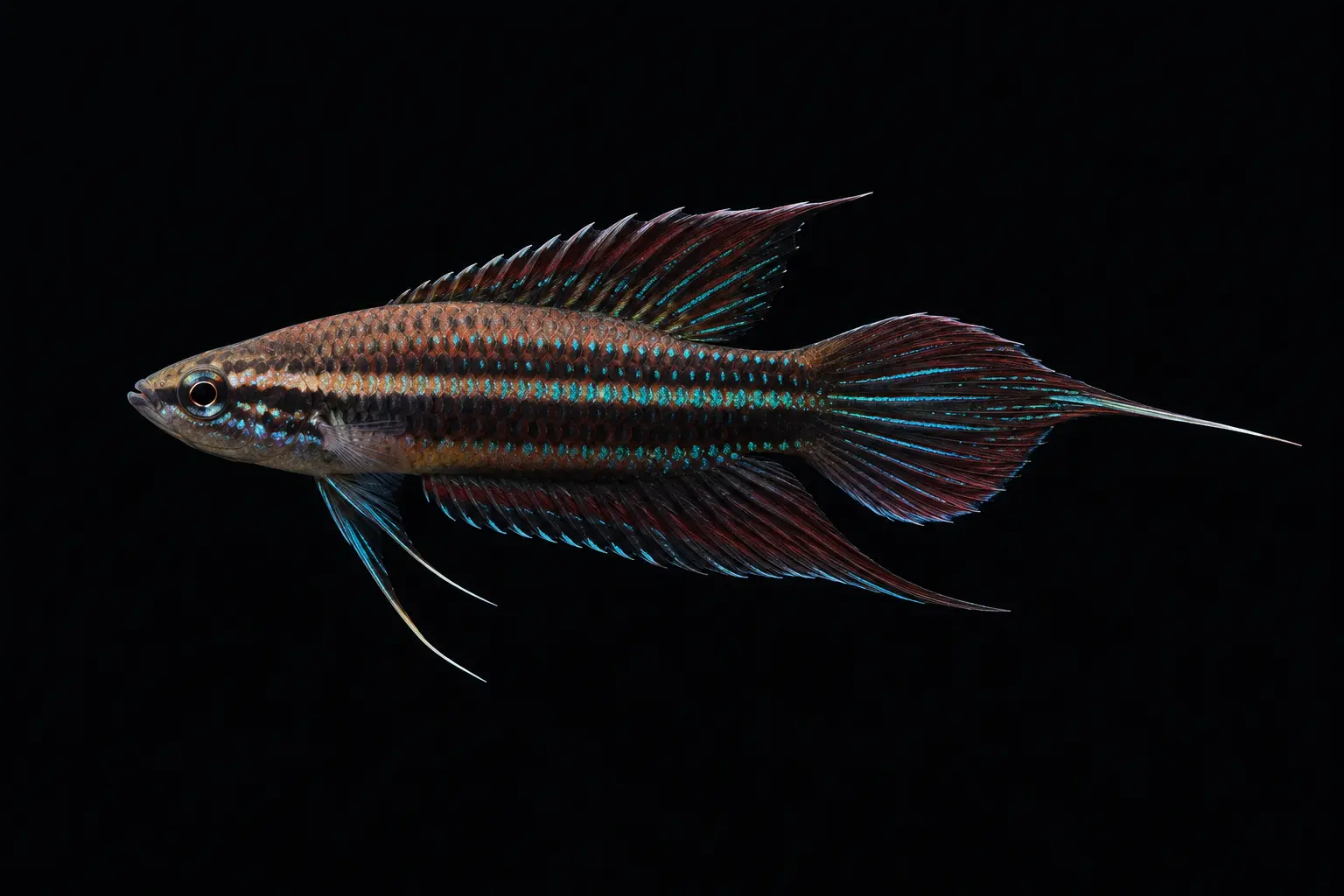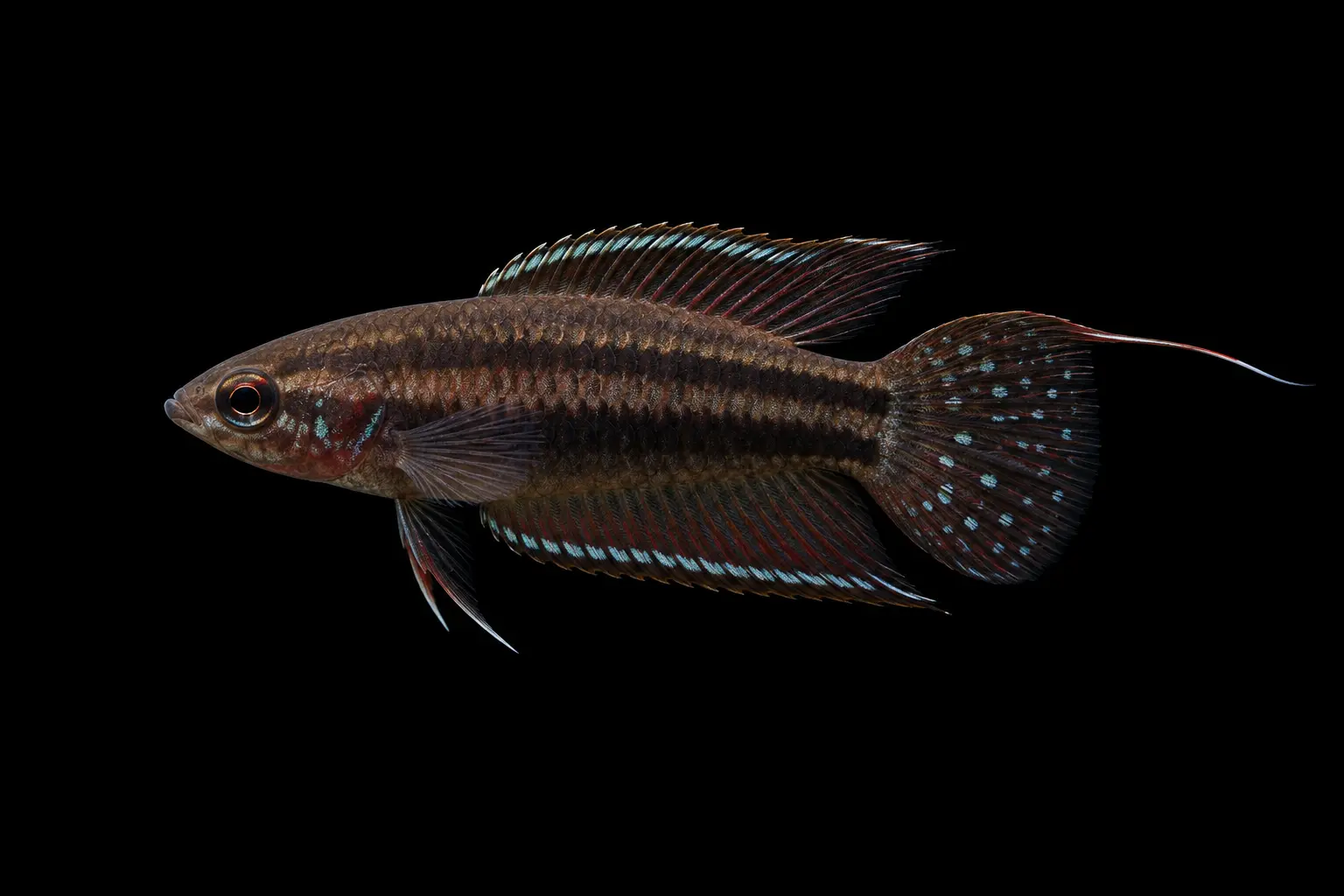
Identity and origin
- Origin
- Bangka Island, Indonesia
- Identity
- Described Indonesian species
The Bangka species has a filamented caudal fin. This name has often been misapplied to other aquarium Parosphromenus.
Habitat and care
Shaded freshwater habitats; consult species-specific peat-water and locality records. Habitat and identity reference
Explore the habitat
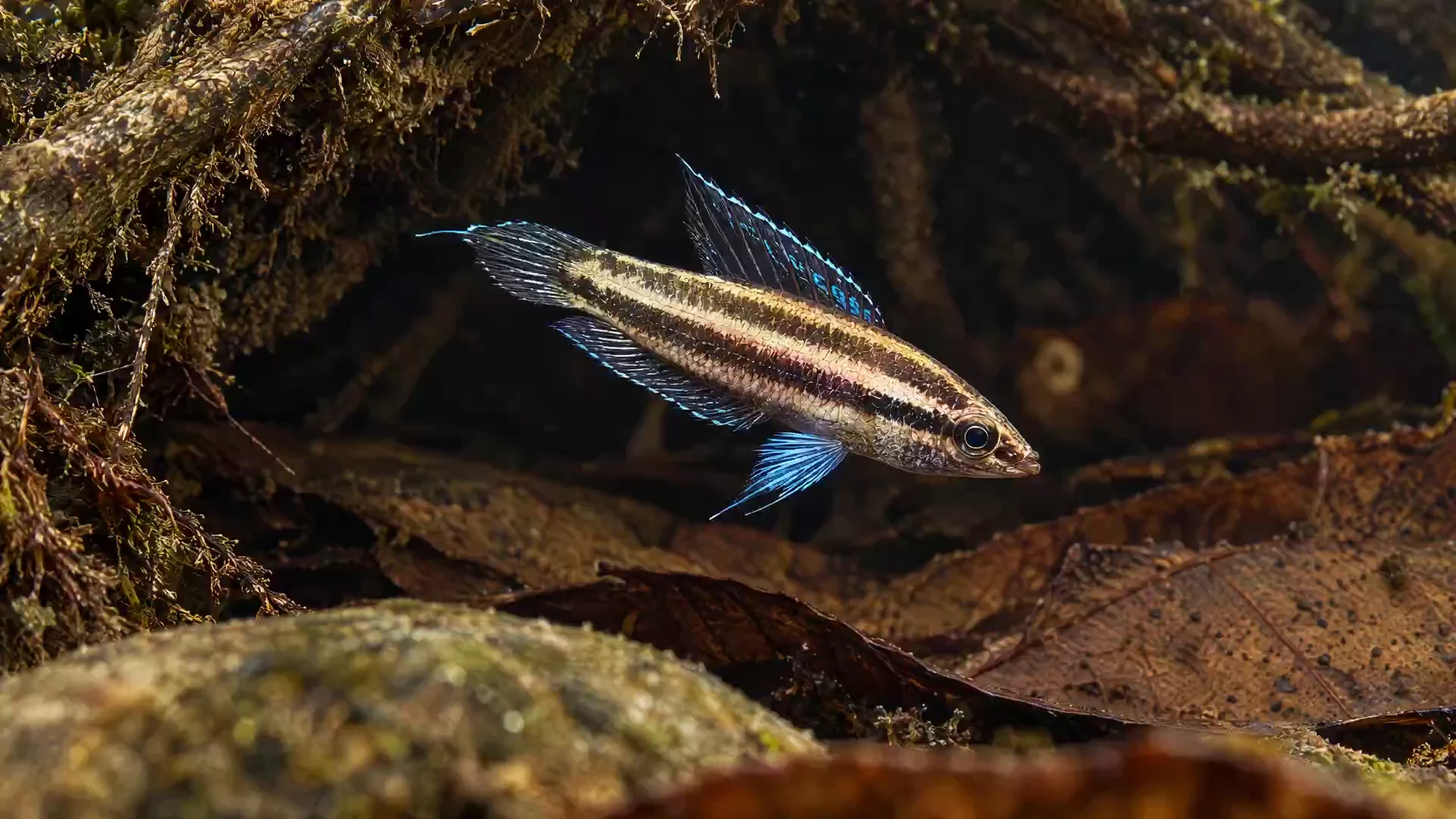
Shaded freshwater habitats; consult species-specific peat-water and locality records.
Illustrative habitat reconstructionFROM THE SIGNATURE COLLECTIONS
Look closely
Mature males have a dark tail filament and separated pale bands in the fins. These details help distinguish true P. deissneri from round-tailed fishes sold under its name.
A detail worth knowing
The name was historically applied to several licorice gouramis. Female identity is harder to assess visually, making locality and breeding-line records especially valuable.
Parosphromenus Project — species account
Source review: 22 September 2026. Educational notes, not a stock or breeding-success claim.
Description
5 cm TL · reported maximum
Temperature 25–30 °C · pH 4–6 · Conductivity 3–75 µS/cm · GH 0 °dGH (test reading) · KH 0 °dKH (test reading)genus guidance
Natural food: Live grindal/microworm; Artemia and Daphnia.Prepared food: Dry/frozen acceptance unreliable.Food guidance at genus level
Biology: mature biofilter; species-specific microbial counts are not established.
Sources & limits
Confirm true P. deissneri identity and lineage; historical trade labels were unreliable. Plan sufficient adult territory and dependable small live food before acquisition. Evidence limits checked: .
Allow more adult space than for the smallest Parosphromenus, with sheltered territories and breeding caves. Maintain very soft acidic water and verify identity; trade names are often unreliable.
Genus guidance, not a validated protocol for every species; temperature varies with species and season. Zero hardness means below kit detection.
Omitted parameters have no verified range in the sources checked. Habitat or experimental measurements are not safe keeping limits. GH, KH, TDS and conductivity are not interchangeable.
General system guidance: target free ammonia (NH₃) and nitrite (NO₂⁻) at 0 mg/L; account for test detection limits. These are chemical measurements, not microbial counts or each species’ tolerance limits. OATA · 2022. Assess biofilter function through waste processing and water tests, not clarity alone. Biofiltration reference.
- Parosphromenus Project · species husbandry account
- Kottelat & Ng (2005), Diagnoses of six new species of Parosphromenus, with a key
- EAZA Parosphromenus Best Practice Guidelines (2024), Table 11
Size checked: . Water/food checked: .
Plan before choosing
- Habitat
- Peat blackwater
- Planning context
- Prepare species-appropriate soft, acidic water, sheltered space and dependable small live food. Keep species and localities distinct. Consult specialist husbandry before acquisition.
Goodwin & Hutchins (2024), EAZA · specialist husbandry, introduction and section 2
Source check: . Independent husbandry review pending.
Planning for licorice gouramis
Care-planning notes. Confirm exact requirements for the species and source population.
- Prepare species-appropriate soft, acidic water and a dependable supply of suitably small live foods.
- Provide shaded cover and breeding shelters. Keep separately documented species and localities distinct.
- Use a specialist breeding guide: regular tap water and a dry-food-only plan are not a reliable starting point.
Evidence record
Conservation record: Reported EN — Endangered. The category is retained from a cited record. Verification of the direct assessment and its dates is not yet documented here. Open the retained source. Conservation status does not establish legal protection, availability or permission to trade.
Identity and locality source check: . Editorial source check; independent taxonomic review pending. Research profile; availability is not open.
Catalogue inclusion confirms a research record, not current stock, legal export, or destination-country import permission.